|
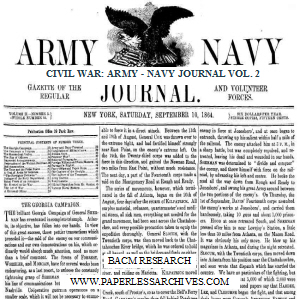
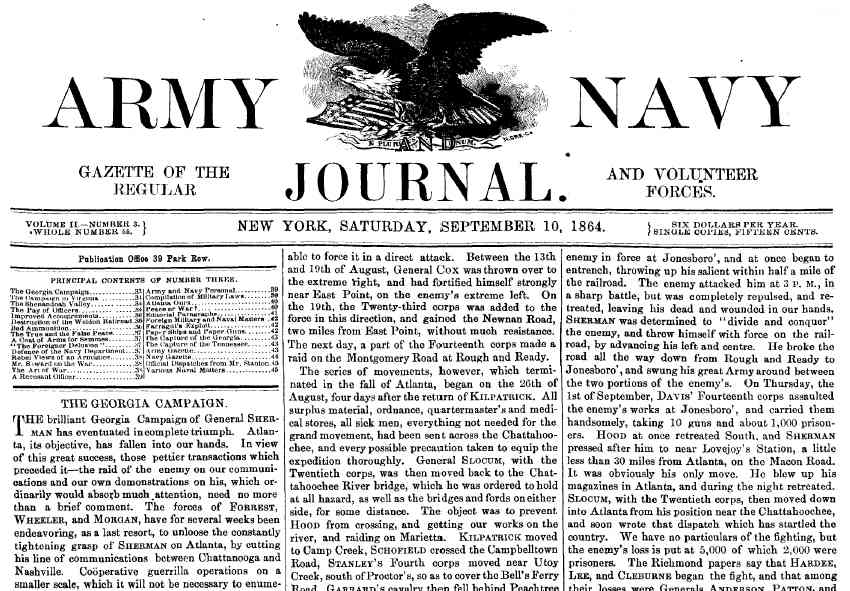
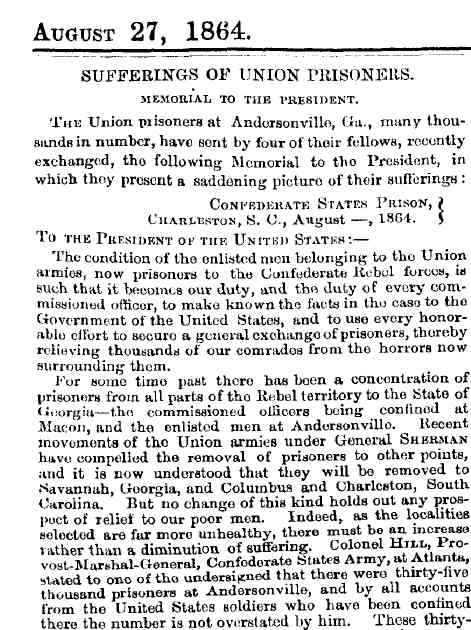
Sometimes called "Army and Navy Journal" or "Armed Forces Journal," these 52 issues date from August 27, 1864 to August 19, 1865. The Army and Navy Journal was the nation's leading military journal of the time.
For more information about the orgin of the Amy Navy Joural see Civil War: Army Navy Journal & Gazette Volume 1 1863 - 1864
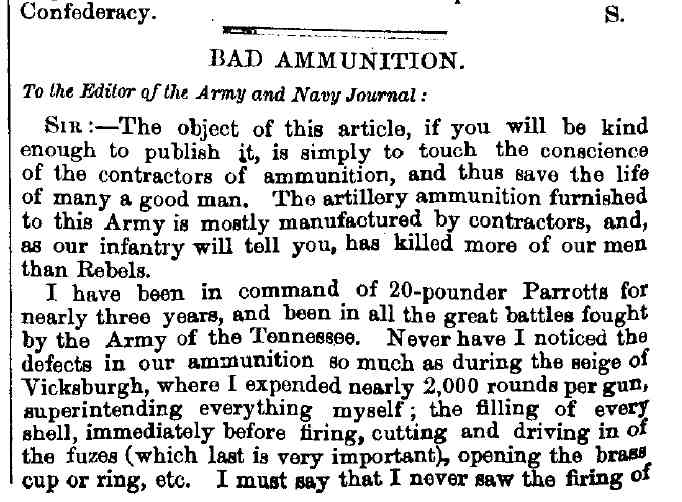
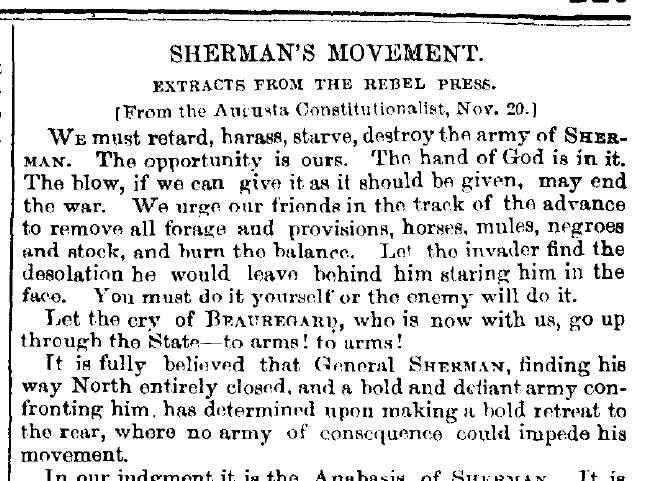
This volume covers all the major Civil War events of the period covered in this volume. In addition to major Civil War events, the Army Navy Journal covered stories of court martials, obituaries, official dispatches from the War Department, appointments, list of AWOLs, foreign military matters, editorials and advertisements. The Journal included reprints of articles from Confederate publications. Southern newspapers including the Greensboro Journal, Richmond Dispatch, Richmond Enquirer, Richmond Sentinel and Atlanta Constitutionist.
Key Civil War events occurring during the period of these 52 issues of the Army and Navy Journal include:
August 1864: Democrats nominate George B. McClellan for president to run against Republican incumbent president Abraham Lincoln.
September 1864: After forcing the Confederate army of John Bell Hood out of Atlanta, Georgia, General William T. Sherman captures the city, a major munitions center for the South.
October 1864: A Union victory at Cedar Creek ends the Confederate threat in the Shenandoah Valley.
November 1864: Lincoln is reelected President, with Andrew Johnson as Vice President, defeating Democrat George B. McClellan. After destroying Atlanta's warehouses and railroad facilities, Sherman leaves Atlanta and begins his "march to the sea," in an attempt to demoralize the South and hasten surrender.
December 1864: General George Henry Thomas leading 55,000 federal troops including African-American troops, wins the Battle of Nashville, decimating John Bell Hood's 23,000 member Confederate Army of Tennessee. Savannah falls to Sherman's army without resistance. Sherman sends president Lincoln a telegram offering the city to Lincoln as a Christmas present.
January 1865: The United States Congress passes the Thirteenth Amendment to the Constitution, which when ratified, abolishes slavery throughout the United States.
February 1865: President Lincoln and Confederate Vice President Alexander Stephens hold a peace conference at Hampton Roads in Virginia. The peace conference fails and the Civil War continues. Columbia, South Carolina, is almost completely destroyed by fire, most likely set by Sherman's troops.
March 1865: President Lincoln is inaugurated as President for a second term. General Robert E. Lee orders his Army of Northern Virginia to attack Grant's forces at Petersburg. The attack is repelled and four hours later, Lee's last offensive move of the Civil War is ended. The Appomattox campaign begins, with Grant's move against Lee's defenses at Petersburg, Virginia.
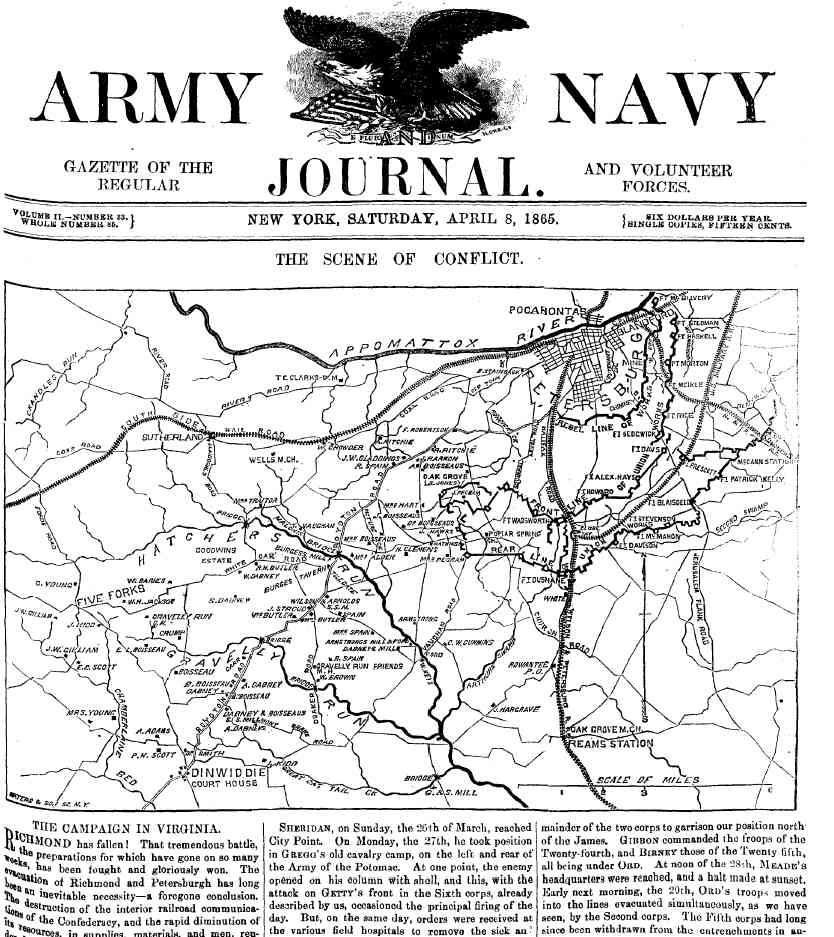
April 1865: Petersburg falls, and the Confederate government evacuates its capital, Richmond. Confederate corps commander Ambrose Powell Hill is killed in action while attempting to rally his men. Union troops occupy Richmond. President Lincoln tours Richmond, where he enters the Confederate White House. Robert E. Lee surrenders the Army of Northern Virginia to General Ulysses S. Grant at Appomattox Court House in Virginia.. John Wilkes Booth shoots President Lincoln at Ford's Theater; Secretary of State William H. Seward is stabbed and wounded in an assassination attempt inside his Washington home. Lincoln dies, and Andrew Johnson is inaugurated as President. Joseph E. Johnston surrenders to William T. Sherman in North Carolina; John Wilkes Booth is shot in a tobacco barn in Virginia and dies.
May 1865: Jefferson Davis is captured and taken prisoner near Irwinville, Georgia. In New Orleans, terms of surrender are offered to General E. Kirby Smith, commander of the Trans-Mississippi Department. His acceptance on June 2 formally ends Confederate resistance, during which 620,000 Americans died.
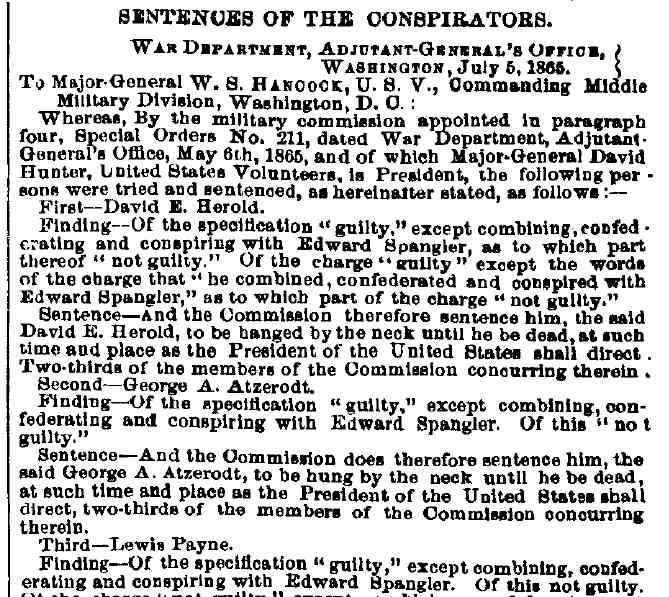
June 1865: All eight conspirators are convicted for the assassination of President Lincoln; four are sentenced to death.
The disc contains a text transcript of all recognizable text embedded into the graphic image of each page of each document, creating a searchable finding aid. Searches can be conducted across all issues in the collection. |